 Understanding Infantilism (.org)
By B. Terrance Grey
Contrary to the rational and practical, the desires of paraphilic infantilism and diaper fetishism commonly focus on a specific diaper type. This is a particularly opportune time to study the factors influencing these desires, because of the diversity of diaper types. In living memory, the most prevalent diaper type has progressed from cloth diapers worn under rubber pants (-1940s), to cloth under plastic pants (1940s-1960s), to hourglass-shaped disposables with a basic plastic backsheet (1970s-1990s), and finally to disposables with a cloth-like plastic backsheet (1990s-).
Survey data was used to compare Adult Babies and/or Diaper Lovers (AB/DLs) by the diaper type they reported wearing as babies, the diaper type they reported preferring in fantasy, birth year, sex, familial stability, and continence. Contrasting the average birth years of AB/DLs who reported being raised in a certain type with the average birth years of AB/DLs who reported preferring that certain type in fantasy showed a shift of roughly four years. This trend suggests that a primary factor in determining an AB/DL's fantasy diaper is the type that was most prevalent during his or her childhood, not necessarily the type he or she wore as a baby. Since the most prevalent diaper type has only changed a few times, the two are often the same.
The author's previous studies have shown an upper limit on the ages at which paraphilic infantilism or diaper fetishism are likely to develop. An interest could be cultivated after this age, but a spontaneous, compulsive paraphilia would not be expected to form. These new results suggest that these desires are often influenced by a childhood reconstruction of his or her own, forgotten infancy; or other secondhand influences, such as the infancy of others or experimentation with found diapers.
In contrast to the preferences of parents or incontinent diaper users, which might be set by practical considerations, AB/DLS might desire one type of diaper over another for reasons that are more difficult to explain. Many AB/DLs have noticed that those preferring cloth diapers and those preferring disposable are usually separated by birth year.
This is a particularly opportune time to study the factors affecting this preference, because of the diversity of diaper types. In the living memory of AB/DLs, the absorbent material has gone from cotton to a superabsorbent polymer (SAP). The classical safety pin was replaced with adhesive tapes, and then with Velcro.
The shell, the most visible part of the diaper, was expected to be the easiest to survey. In the days of cloth, the diaper might be used without a waterproof cover. However, a separate, waterproof pant was often used. Initially, these pants were made using rubber or rubberized cloth. Later plastic with rubber or elastic hems was used. The bare cloth diaper remained iconic.
With the disposable diaper, the shell became integrated with the absorbent material. Disposable diapers were available before Proctor and Gamble chose to enter the market, but did not have much of an impact. Test-marketing for Pampers® started in 1961, with a national rollout in 1966 (Parry, 2001; Richer, 2009). They initially were rectangular and used the wingfoldDEF, previously used with cloth diapers. They included a simple, plastic backsheet. However, the rectangular disposables never gained dominance.
In 1976, Luvs marketed an hourglass-shaped disposable (Richer, 2009). The hourglass shape followed the structure of the waterproof pants, as opposed to that of the cloth diaper. This required elastic in the hems and so was more difficult to manufacture. Other brands soon adopted this shape. By 1976, 50% of U.S. diaper changes were disposable, growing to 80% in 1982 and 95% in 1999 (Parry, 2001).
In 1994, a "cloth-like" backsheet was added to Huggies. In attempting to look like a bare cloth diaper, "cloth-like" backsheets brought the development of the shell superficially full-circle. Alternatively, the "cloth-like" backsheet might have been intended to seem less disposable-diaper-like: In 1994, Kimberly Clark also introduced Goodnites® (Richer, 2009).
For brevity, these disposable types will be called Rectangular, Hourglass, and cloth-like, respectively.
This history is of interest because it permits the study of how the diaper types used on AB/DLs as babies affected the diaper types that they fantasize about later in life. Understanding why a particular type of diaper is the focus of desires might offer some insight into why diapers are central, and indirectly, into paraphilic infantilism or diaper fetishism.
It was generally believed within the community that most AB/DLs prefer the type of diaper that they used as a baby. This was interesting, since, according to a previous survey, the majority of AB/DLs have no memories from age zero to three (Dave, 1997). In this, AB/DLs might not differ from those in the general population, whose earliest memories were at a mode age of three to four years of age (MacDonald, Uesiliana, & Hayne, 2000). This infantile amnesia (also called childhood amnesia) would separate most child AB/DLs from their infancy and diaper use. As a result, the majority of AB/DLs wouldn't remember what type of diaper they wore as a baby. The AB/DL might know which type he or she wore from pictures or diapers still around the house, but wouldn't remember actually wearing them.
To provide a deeper and more detailed understanding AB/DLs, the author composed a 64 question survey and posted it to understanding.infantilism.org as the second in a series of surveys. It was announced to a number of email and web-based AB/DL communities including aby.com, ADISC.org, BBIF.org, dailydiapers.com, foxtalestimes.com, bedwettingABDL.com, and rupadded.com. Inclusion as an AB/DL was by self-identification (in survey 2, question #3, or S2Q3). Participation was voluntary and anonymous.
Due to the author's background, the survey was implemented as a web form, which emailed raw responses to the author. Responses were collected from 2008 to 2009. Responses with an incomplete birth year (S2Q6) and those that, based on the entered birth year, might have been from participants under 18, were deleted. Responses that were probably duplicates were also deleted. Given the implementation of the survey, it was possible for the participant to send exact duplicate responses simply by clicking on the button to submit the response multiple times.
If necessary, the entered birth year was reformatted manually. For example, a birth year entered as "62" would have been corrected to 1962. Omitted responses were completed if obvious from present response. For example, omitted answers about an AB/DL's siblings, such whether the AB/DL's younger siblings were twins (S2Q14), were completed if the AB/DL reported one or fewer younger siblings in S2Q11 and S2Q12. Some blank values in responses were replaced with the text "blank" if necessary.
Essay answers were entered into larger text-entry windows, which might not have provided the participant with spell checking or other usability features. To compensate for this, papers quoting these text will correct spelling, punctuation, and other minor errors while preserving phrasing, terminology, etc. The end of the survey included a checkbox where the participant could opt-out from being quoted.
This survey included questions about specific types of diaper, the importance of diaper type, and other factors. To maximize the independence of the questions about the diaper type that the AB/DL wore as a baby and the diaper type he or she would prefer in fantasy, the questions were in different sections.
There are many different ways in which a diaper could be categorized, including closure (pin, tapes, Velcro, pulled-up, convertible, etc.), inner texture (birdseye, flannel, terry, gauze, nonwoven plastic, Attends® microporeDEF, etc.), backsheet, etc. The backsheet was selected because it would be the most visible. The contrast also required reducing all possible combinations onto a single axis. This is why there were not additional options, for example, for plastic pants worn over disposables. Finally, the desired contrast was with diapers from babyhood, so training pants and bedwetting undergarments were not included. These might be covered in later surveys.
The question about the diaper type worn as a baby included options for AB/DLs who did not know what type they were raised in, as well as non-diaper options, such as elimination communication. Similarly, the question about the fantasy diaper type included an option for those who desired a diaper but were not particular about the type, and options for those whose fantasies did not involve diapers. An essay question, on the participant's fantasy diaper and what influenced it, was also asked.
The results included here will include AB/DLs only: While it would be interesting to contrast AB/DLs and non-AB/DLs, few non-AB/DLs completed the survey.
A total of 997 responses were received for this survey, excluding responses from potential minors and probable duplicates. Of these, 862 self-identified as AB/DLs and completed all the relevant questions. The questions relevant to this paper are self-identification on the AB-to-DL range (S2Q3), sex (S2Q4), birth year (S2Q6), diaper type worn as a baby (S2Q7), adoption or foster care (S2Q16), fecal incontinence S2Q32, urinary incontinence S2Q33, diaper type preferred in fantasy (S2Q58), and importance of diaper type (S2Q61).
Chi-squared analysis was used to check multiple-choice questions or pairs of questions for statistical significance. Welch's t-test was used to test the birth year contrasts for statistical significance. Post hoc, the Benjamini-Hochberg procedure was used to test pairwise comparisons for significance within questions or question pairs that had shown a significant contrast. A 95% confidence and 5% false discovery rate was used.
Figure 1 shows the diaper type that AB/DLs reported wearing as babies, as a percentage of five-year groups by birth year. The diaper types are arranged roughly chronologically, proceeding from early types near bottom, to the most recent type second from the top. The top section, without color, represents the percentage of AB/DLs who reported being unsure of the type that they wore as babies.
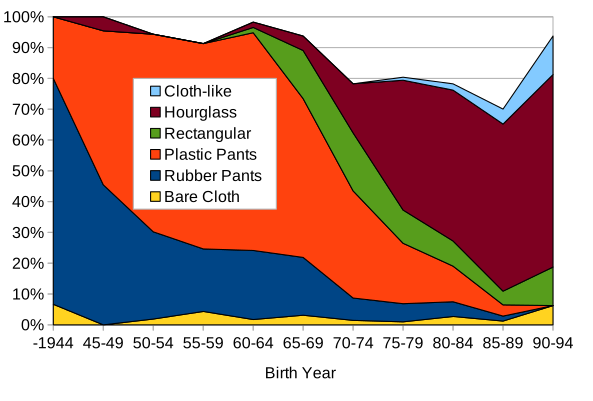
As expected, there is a sequential dominance. AB/DLs born in the '40s experienced the decline of rubber pants in favor of plastic pants. The dominance of plastic pants continues until the rise of the disposables. The rectangular disposables, while leading the transition, never actually gain dominance. The hourglass-shaped disposables became dominant instead.
The transitions line up with expectations based on the U.S. market, with a few exceptions. For example, some AB/DLs who reported wearing Cloth-like were older than expected. Those in the 1985-1989 birth year group would have been between five and nine years of age when those diapers were introduced. Three participants from older groups also reported wearing them, with oldest being seventeen at introduction. This might be due to the use of "cloth-like" backsheets for bedwetting and training pants, such as Goodnites®.
Some variation from the U.S. marketplace was expected, since the survey did not restrict its sample to AB/DLs raised in the U.S. One European type not included in the U.S. progression included a disposable, rectangular pad and a somewhat reusable plastic cover. This separate cover was hourglass-shaped with extended tabs. "Those were the ones that were around when I grew up in the 1970s. They are rectangular, white, 'cloth-like' with no plastic backing. Although later came some variants that had plastic backing. They are held in place by specially designed thin sheets of plastic that are tied at your hips in order to keep the diaper in place." This man, born in 1968, reported being raised in rectangular disposables. However, the multiple-choice categories were ambiguous for that type.
Along with the rise in disposables came a rise in those who did not remember what kind of diaper they were raised in. This might be due to the tendency to re-purpose cloth diapers as rags, keeping them in the household. In contrast, the disposables might typically be used up or given away. Diapers kept around the house could serve as reminders or clues.
Only one participant reported not having been raised in diapers. The male, born in 1955, couldn't be reached for confirmation. He reported fantasizing about hourglass-shaped disposables.
Overall, 19% (164) of AB/DLs reported considering the diaper type to be critical and an additional 54% (467) of AB/DLs reported having a preferred diaper type. These percentages differed from those seen in the first survey in the series, specifically S1Q27. The first survey question included only one option for those with a preferred diaper type, while the second survey question offered two options.
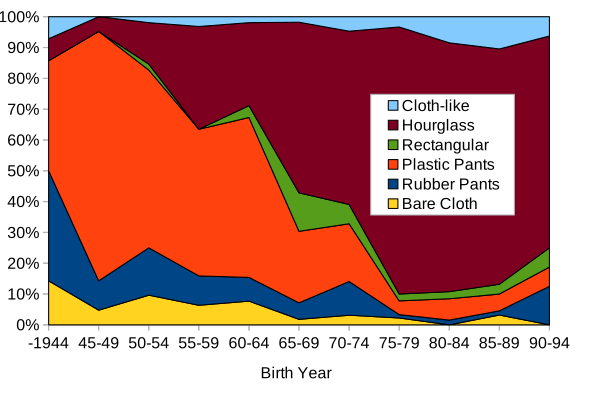
The diaper type that AB/DLs reported preferring in fantasy, were not for practical constraints, is plotted by birth year in Figure 2. For clarity, groups of five years are shown. This plot included only AB/DLs with a specific, preferred fantasy diaper type. Ten percent (84) of AB/DLs reported not having a preferred fantasy diaper type. Similar to Figure 1, the plot shows a sequential dominance. However, it is shifted temporally. Figure 2 doesn't include most of the decline of rubber pants, included in Figure 1. Figure 2 might also show the start of "cloth-like" disposables' rise to dominance.
Many participants expressed the view that the fantasy diaper type was determined by the type worn as a baby. When asked what influenced their selection of fantasy diaper, many responded along the lines of "it was the kind of diaper I was raised in."
Some reported remembering wearing diapers. "I can remember back to when I was 2 years old, and I wore the Pampers® from the 1980s." Another wrote "I still remember being in diapers and they were disposables that made very loud crinkling noises whenever I moved, so that sound is very closely associated in my mind with being a baby. More modern diapers just don't feel 'right' without the crinkling." Others might have extrapolated based on what they wore for bedwetting. "...a terry nappy covered with frosted white plastic pants. It's what I remember wearing when I was a baby (and bedwetter)..."
A few conceded that they couldn't consciously remember wearing diapers. "My selection was most likely influenced from being diapered in the exact same type of diaper when I was a baby. Although I have no specific memory of being diapered as a baby, throughout childhood I was aware that these types of disposables [hourglass-shaped] were the most common, and had also seen them used on my younger brother." Another man reported that his preferences were set by "probably a subconscious memory of what I wore as a baby."
For clarity, two responses were not plotted. They selected one of the non-diaper options for the multiple choice question but described diapers in the following fill-in question.
Anecdotally, it might be interesting to note that bare cloth apparently benefited only slightly from cartoons, if at all. One man, born in 1990, wrote that "there was this old Donald Duck cartoon ([Modern Inventions, 1937] where the duck jumped into an automated baby-minder carriage and was trapped and diapered, and prevented from keeping them off... the cartoon really stuck with me." He reported having been raised in rectangular disposables, but preferred cloth with plastic pants. The cartoon showed a bare cloth diaper, folded triangularly and held in place with a single safety pin in the front. This is the typical diaper shown in cartoons, even if the dialogue was about disposables (e.g. Boyer, 1991).
Another cartoon, "Rugrats," is notable in that the characters clearly wore hourglass-shaped disposables, then in common use. "What influenced my fantasy diaper most was the design of the diapers that were worn by the characters in the old show Rugrats" wrote one man, born in 1994. He was raised in and preferred hourglass-shaped disposables.
Qualitatively, the features on Figure 2 seem to lead those of Figure 1. This is consistent with what would be expected if the diaper preference was set some time after infancy, to the diaper type that was most prevalent at the time. The average birth years can be used to compare the figures quantitatively, as shown in Table 1. The calculation for type raised in includes only those AB/DLs who reported remembering a specific type (N=706). The calculation for fantasy type only included those who reported a specific preference in both S2Q58 and S2Q61 (N=616).
| Raised in | Fantasy type | ||||||
| M (SD) | n | M (SD) | n | t, p | |||
| Rubber Pants | 1959.8 (13.6) | 97 | 1962.4 (15.4) | 34 | t(52.23)=0.89, p=.4 | ||
| Plastic Pants | 1964.1 (10.7) | 238 | 1960.5 (12.4) | 121 | t(212.12)=2.69, p=.008 | ||
| Bare Cloth | 1971.7 (15.0) | 18 | 1961.8 (12.8) | 20 | t(33.67)=2.19, p=.036 | ||
| Rectangular Disposables | 1977.1 (7.3) | 60 | 1975.5 (9.6) | 22 | t(30.57)=0.74, p=.5 | ||
| Hourglass-shaped Disposables | 1983.4 (5.3) | 275 | 1979.0 (9.3) | 372 | t(610.85)=7.61, p<.001 | ||
| Cloth-like Disposables | 1986.2 (3.5) | 18 | 1980.1 (10.7) | 47 | t(62.10)=3.45, p=.001 | ||
For individual types, the contrast was significant for cloth diapers and plastic pants, Hourglass, and Cloth-like. (At .036, bare cloth had the fourth-lowest p value, but per the Benjamini-Hochberg procedure with a 5% false discovery rate and six comparisons, the fourth-lowest p value would have needed to be under .033 to be significant.) The mean lead, weighted by prevalence by fantasy type, was 4.06 years. Taking the root-sum-squared of each standard deviation, and weighted by prevalence by fantasy type, gives a standard deviation of the mean of 0.51 years.
Since bare cloth and rectangular disposables did not have a period of dominance, either in use or preference, their birth year differences aren't meaningful. Only 11% (2 of 18) of those who reported having been raised in bare cloth reported a preference for them. Of those who reported having been raised in Rectangular, 60% (36 of 60) reported a preference for Hourglass and only 22% (13) reported a preference for Rectangular. This suggests that the most prevalent diaper during one's childhood is more influential to his or her tastes than what he or she wore as a baby. The lead would then be due to the average age at which this influence occurred, or the ages around which the influences were distributed. This average age would be a four year contrast plus the one to three years spent in diapers, or roughly five to seven years of age.
Comparing birth years for the type worn as a baby to the type preferred as an AB/DL suggests a specific trend: AB/DLs tended to prefer the type of diaper in common use when they were children, not necessarily what they wore as babies. The four year difference is relative, so the average age range would be four years after babyhood. This would be an average value, since the secondhand influences would occur at varying ages. The prevalent type of diaper during one's childhood will influence what siblings and neighbor's babies are wearing, what is in the stores, what is being advertised, etc. This later diaper type might also affect early experimentation with diapers.
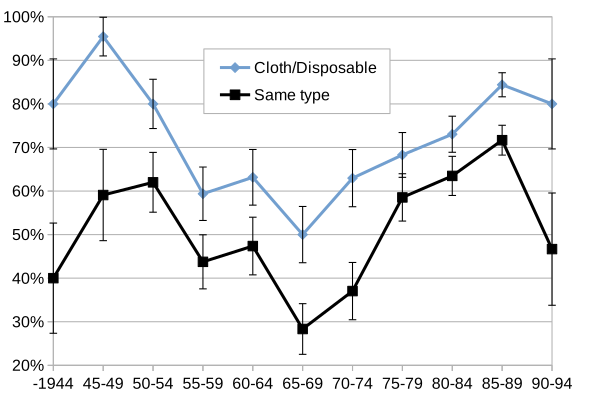
The percentage of AB/DLs who report having the same fantasy type as the type they used in infancy is plotted in Figure 3. The lower curve is the percentage of AB/DLs who had the same type. The upper curve includes those who were raised in and preferred any of the three cloth types, or were raised in and preferred any of the three disposable types.
The two peaks correspond roughly with the dominant periods for plastic pants and hourglass-shaped disposables. The central valley corresponds roughly with the transition from cloth and plastic pants, through rectangular disposables, to hourglass-shaped disposables. The declines on the left might be due to the rubber to plastic transition, and the decline on the right might be due to the hourglass-shaped disposable to the "cloth-like" disposable transition. Since the cloth vs. disposable curve also declines at the ends, this is uncertain. Except for these transitions, the type an AB/DL wore as a baby, the type he or she saw on TV, the type the neighbors' younger children were wearing, etc., would often be the same.
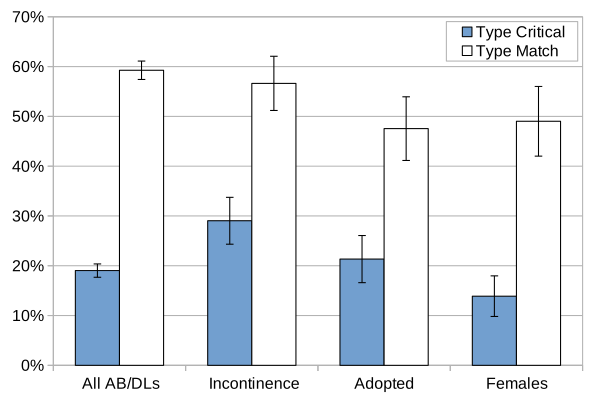
AB/DLs who reported being incontinent, having been adopted or placed in foster care, or were female might be thought to be special cases in the relationship between the type of diaper worn, and the type preferred in fantasy. However, the probability of having the two diaper types match did not vary significantly Χ2(3)=2.34, p=.5. Additionally, the groups did not vary significantly in their probability of reporting the diaper type to be critical, Χ2(3)=7.03, p=.07, but the differences might reasonably have been significant if the sample sizes were larger.
In the search for a better understanding of why some desire to wear diapers, it is helpful to consider what kind of diapers they desire. While the type of diaper that an AB/DL desires to wear is often the type that he or she wore as a baby, the data suggests that this is largely coincidental. Contrasting the ages of AB/DLs who report having been raised in certain types of diapers with those who report desiring to wear those types of diapers shows a lead of roughly four years. That is, the trend was for an AB/DL to desire the type of diaper that AB/DLs roughly four years younger would report having been raised in. The two types are often the same, since recent history tends to have one dominant diaper type which rarely changes. For birth years close to such a change, the probability of preferring the type worn as a baby drops.
The dominant type has progressed from cloth diapers with rubber pants, to cloth with plastic pants, to hourglass-shaped disposables with a simple plastic backing, to disposables with a cloth-like plastic backing. Two other types included in the survey, cloth used without a waterproof cover and rectangular disposables, did not achieve dominance within the birth years represented in the survey. Most who were raised in one of these two types reported a preference for another type.
These observations provide some insight into the limited role that one's own babyhood and infantile experience with diapers has in the development of paraphilic infantilism or diaper fetishism. For most AB/DLs, their desires towards babyhood are influenced by an idealized reconstruction of infancy, and not necessarily their own. The data couldn't isolate the effect of childhood experimentation with diapers, but it suggests that exposure to diapers as infants or as adults has a limited influence at most over the preferred type of diaper. This suggests that the desires for diapers and/or babyhood generally take their adult form some time after most AB/DLs are out of diapers and have forgotten their own babyhood, but before they are adults themselves.
Of course, this study is not without limitations. It is based on retrospective self-reports of AB/DLs who might, not remembering their own infancy, had to infer what type of diaper they wore from baby pictures or other clues. Additionally, the observed average lead in fantasy diaper type might be the result of a) similar, early determination; b) dissimilar infantile determination and a later determination averaged together; c) early childhood reconstructions of infancy influencing determination, before they are replaced with better inferences later into childhood; or d) a mix of all three. It is unclear how future research will be able to eliminate this confounding. Additionally, the sample of this study did not adequately represent the effect of cloth-like disposable diapers, due to the birth year distribution of the participants. A later survey might yield interesting observations on how being raised in what is, by design, the least diaper-like type of diaper will affect AB/DLs.
Email BitterGrey![[mail]](../figures/email_icon.gif) Last Update: 27 Dec 2016| First: 1 October 2009
Last Update: 27 Dec 2016| First: 1 October 2009
Do you have Questions, tips, suggestions, or other feedback?
![[icon]](../figures/puzzle_ref.gif) Books and Other References:
Books and Other References:

This work is licensed under a
Creative Commons Attribution-Noncommercial-Share Alike 3.0 United States License.
For online material based on this work, include a link to either this page, the
AB/DL Surveys Project index, or the
website's main index. For printed material based on this work, include a citation with one of those three URLs.