Understanding Infantilism (.org)
Summary - Method - Results and Discussion - Conclusion

AB/DLs in Diapers Already

-By B. Terrance Grey
Part of the Survey Project at Understanding.Infantilism.Org

Summary

If there is one commonality typical of AB/DLs, it is the desire to wear diapers again. However, even this is not universal. While many AB/DLs wondered what it would be like to be back in diapers, some did not. This is because they were still in diapers or were back in them already, before their desires surfaced. They might have bedwet into their childhood, or been incontinent.

This report attempts to explore the effect of being in diapers by contrasting AB/DLs who were or were not in diapers when their desires surfaced. It discusses a number of statistically significant contrasts. However, many of the contrasts could be explained by factors external to the paraphilia. For example, the interests of those who were in diapers longer were impacted by struggles with the themes of control and babyhood. As a result, they tended to report either embracing or shunning those themes. Furthermore, those who wear diapers regularly for a need might be more able to overlook or deny their desire to wear them, and so be less likely to complete surveys like the one these results are based on. Two results presented are consistent with a missing group, both in diapers and in denial, that tends to be heterosexual and tends not to have viewed a desire to wear diapers positively.

There were also results that weren't affected by these experiential differences. Specifically, the age of onset for AB/DLs in diapers has a similar distribution to that of AB/DLs who were not in diapers. This suggests that the dominant factors affecting the development of paraphilic infantilism or diaper fetishism are similar between the two groups. A factor which is not common to the two groups, being in diapers into childhood, would then not be dominant.

Based on these observations, it seems clear that AB/DLs who stayed in diapers are not that different from AB/DLs who, after getting out of diapers, wanted to return to them. AB/DLs who are incontinent or who bedwet might have had very different experiences than AB/DLs who did not. However, except for the effects of that experience, they and their desires are not that different.

Method

A 38-question, online survey was composed and posted to the Internet at the author's website, understanding.infantilism.org. The questions briefly explored the interests, practices, and backgrounds of AB/DLs. The survey was announced to a number of email and web-based AB/DL communities. The following correlations only include responses that answered all of the questions involved in the particular correlation.

The responses were tabulated using a custom analysis program. This program, written in C, also generated question summaries and crosstabulations.

To avoid averaging across dissimilar groups, the data presented here will be for non-transgendered, AB/DL boys who selected one of the first five onset types. This subsample includes 83% of the completed surveys. Given the low number of responses with a late onset (after age 20), this study will focus on early (to age 9) and teen (10-19) reported onset ages.

Onset

In this study, onset refers to the first awareness of the desires wear diapers or act like a baby, or the first action along these lines. The onset age would then be the AB/DL's age of this first memory either of having uncommon desires or acting upon them. One factor complicating the study of paraphilic infantilism and diaper fetishism is that their causes and the observation of their effects might be separated by long periods of time. The average age of onset of AB/DL-related desires for boys was 9.8 years[1]. This would be the age at which the surveyee first remembered having an unusual desire for diapers and/or babyhood, or remembered acting on those desires. If these desires are rooted in a time when the boy or girl was in diapers, then the cause would be separated from the effect by several years in most cases. This study will contrast a special case - those who were still in diapers

Each surveyee was asked to choose the most appropriate onset type and age. There were seven options for the onset type, in addition to a fill-in-the-blank area. The first option is referred to as 'always': 'My interests were there before, but at some time I realized that I was different; that others around me didn't share the interest.' The second, 'event': 'My interests were probably caused by a specific event (stumbling across a reference to AB/DL activities somewhere, getting introduced to it, an incident of emotional trauma, trying a new kink, sexual abuse, etc.)' The third, 'date': 'My interests started at a certain time, but I'm not sure what event caused them.' The fourth, 'practiced': 'I remember acting on my interests in diapers and babyhood, but don't remember when they started or when I realized that they made me different.' The fifth, 'in diapers': 'I was wearing diapers already for bedwetting or incontinence, and noticed that I was starting to enjoy wearing them or being a baby.'

The two remaining options were for those who decided to add elements of diapers or babyhood to existing BDSM, ageplay, etc., interests, or who still aren't interested in diapers or babyhood.

The age associated with these recollections would be an upper limit. The desires would have formed either at that age or at some time before.
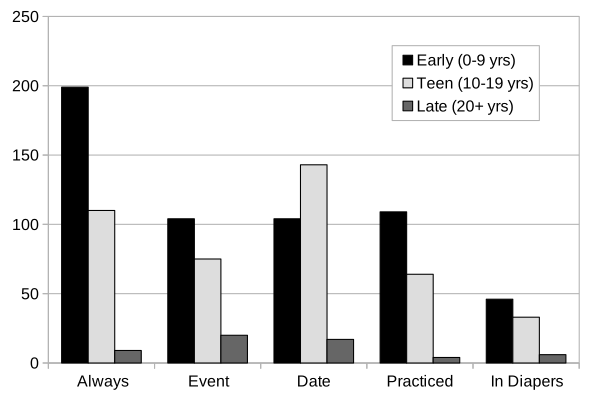
While the survey presented the onset types in an order that amplified their contrast, the onset types will be presented here in order of affinity. 'In Diapers' will arbitrarily be listed first.

Let's consider a hypothetical AB/DL, who was in diapers for bedwetting, and who's desires started at that time. At five years of age, he would then outgrow his bedwetting. At nine years of age, he experienced a desire to be in diapers again. At eleven, he improvised a diaper to explore these urges. If he remembered being in diapers when his desires started, he would select 'in diapers.' However, if he forgot those early years in diapers but remembered having the desires, he might select 'always.' If he had also forgotten having the desires, he might only remember improvising the diaper later. He would then select 'practiced.' Since memory, particularly of early childhood, can be cloudy, considerable crossover between onset groups is expected.

Two contrasting groups remember a time before they desired to wear diapers. Since some events are forgotten, and some other events are merely coincident with the start of desires, the selection between 'date' and 'event' is also inexact. There also may be some crossover between these two and the three above.

Figure #1 - A bar chart showing the sample size, broken down by onset type and age. for non-transgendered male AB/DLs.

Results and Discussion

The majority of AB/DLs follow a typical profile. They were raised in diapers, but were taken out of them at toilet training. Then, years or decades later, they desired to wear diapers again. Often, they are without a clue about why their desires occurred. In contrast, there are some AB/DLs who were in diapers late, or who were put back in them for some reason. Comparing the two groups can show us a little about both groups.

There is a classic cause-and-effect story that is often retold: A pubescent boy goes through early sexual experiences in diapers. Diapers and sexuality become associated, and a lifelong diaper fetish is cemented. "I had worn a Goodnights® pull-ups type diaper to bed, and realized that the feeling of the diaper was giving me an erection. At the time, I had no idea what exactly was happening beyond that it felt nice. I'm pretty sure that night was where my interest in diapers started." This boy was 14, and meets Criterion B, so he might be diagnosed with a diaper fetish. However, he did not report a preference for diapers over a sexual partner.

This cause-and-effect story is of interest to AB/DLs who weren't in diapers at puberty because it offers an intuitive explanation, even though it might not be relevant to them. In addition to exploring an interesting group of AB/DLs, those in diapers already, the following analysis should be of interest to all AB/DLs, even though it might not directly answer what caused their own interests.

Effects

Since the story mentions diaper fetishes as an effect, it seems a reasonable place to start. Figure #2 plots the percentage of AB/DLs who have diaper fetishes to the degree that they find diapers more arousing than any imaginable sexual partner. The percentages are per onset age and onset type. The fourteen-year-old quoted above would not have been included. While he had an interest in diapers, he didn't report considering them to be more arousing than a sexual partner.

Figure #2 - A bar chart showing the distribution of preferences for diapers over sexual partners, one definition of diaper fetishism.

Boys in diapers who reported an early onset (before age 10) were more likely to develop a preference for diapers over either a male or female sexual partner. That is, they were more likely to develop a diaper fetish than other male AB/DLs who reported an early onset. (18% vs 11%, p = .06). However, this was not true of teens, who weren't significantly more likely to develop a diaper fetish than other teen AB/DLs. (10% vs. 12%, p=.3) A group not included in the data, those who were both in diapers and in denial about having paraphilic infantilism or diaper fetishism, would likely not report having a diaper fetish. Including them would further increase the contrast among teens. This group will be discussed further later. It is possible that not only aren't teens more likely to eroticize diapers if in them during puberty, but that needing to wear diapers during puberty could actually prevent diaper fetishes. Among teens, those with 'always' and 'practiced' onset types were more likely to report having a diaper fetish than other teens. (16% vs. 9%, p=.005).

This suggests that the classic cause-and-effect story might be more anecdote than archetype. Those who go through puberty in diapers aren't more likely to develop diaper fetishes than those who do not.

The data actually suggests a trend for diaper fetishes to form before ten years of age for those in diapers. Depending on the timing of their being taken out of diapers and the quality of their memory, they might not report an early onset. They might report becoming aware that others didn't share desires they seem to have always had. Alternatively, they might remember improvising a diaper but not the urge to do so. These two groups would report either 'always' or 'practiced.' Their first remembered awareness would be in their teens, having forgotten part of their early childhood.

Figure #3 - A bar chart showing the distribution of male AB/DLs by sexual orientation.

The survey also asked about sexual orientation, using a five-point range between heterosexual and homosexual. Those who reported being in diapers at onset were less likely to report being heterosexual, but this is only significant for those with a teen onset. (58% vs 64%, p = .2 for early onset, 42% vs 60%, p=.008 for teen onset.) This tendency toward homosexuality with teen onset was also true for another group. AB/DLs who reported always having desires for diapers or babyhood, but not realizing their significance until their teens, were also less likely to report being heterosexual. (50% for 'always' vs. 63% for the other onset types, excluding 'in diapers,' p=.004). Since AB/DLs are a heterogeneous population, there might be a number of reasons for the differences in the distribution of sexual orientations.

The distribution for sexual orientation is plotted in Figure #3.

One possible cause involves two notable groups, caused by cultural barriers. Typically, there are two barriers to becoming an AB/DL. The first cultural barrier is the common stigma associated with diaper use, and the second is the social pressure to conform to some ideal. This ideal is often called "normal" although it includes influences from professional athletes and action-movie heroes who are far from average. Even with these extremes aside, non-AB/DLs are a heterogeneous population. That is, 'everyone else' isn't like 'everyone else' either. The pressure to conform is usually not held accountable to these inconsistencies. For discussion here, "normal" effectively means 'not gay, not wearing diapers, and not wanting to wear diapers.'

Those who had already given up being "normal," because of homosexuality for example, would be more likely to admit being an AB/DL if they were so. They would also be more willing to try AB/DL activities, even if they did not have paraphilic infantilism or diaper fetishism, out of mere curiosity. One barrier would already be down. This group would then tend to not seek a cure. The fact that only 45% of 'always' teen-onset AB/DLs sought to cure their interests, in contrast to 54% of other teen-onset AB/DLs (p=.03), suggests that their high incidence of homosexuality might be due to the presence of this first group.

This group might also be present among those reporting being in diapers and having a teen onset. However, since they weren't less likely to seek a cure (54% 'in diapers' vs 54% other, excluding 'always') the presence of this group doesn't explain the distribution of sexual orientations. They would be about as frequent in both sets, and so wouldn't cause a difference between sets.

The size of this first group is suggested by comparison with other studies that rated sexual orientation on a scale. (Comparing studies that used a scale with studies that did not requires an assumption about what bisexuals would have reported being if they weren't presented with only two options, heterosexual and homosexual.) In studies that used the seven-point Kinsey scale, 2-8% reported being homosexual. [2][3] The AB, DL, Etc. survey had six options; a five point orientation scale and a 'solo' option. In it, 11% of AB/DLs reported being homosexual. A seven-point orientation scale might have given a lower result. The difference in scales and the range in published results limits the certainty of any conclusions about the relative distribution of sexual orientation.

For heterosexuals, the normalcy barrier would work in the opposite direction. Those who are struggling to preserve a "normal" self-image would be less likely to identify as being an AB/DL. If given a choice, that is. Typically, paraphilic infantilists and diaper fetishists would be driven by their desires. The first driven action would be to admit to themselves that they had desires and that they wanted to wear diapers, in effect, that they were AB/DLs. However, this can be skipped if they were already in diapers for some other reason. Like a hunger or lust, paraphilic desires build up when they aren't gratified. This group would be able to retain a more 'normal' self-image, either by denying their desire to wear diapers, or being unaware that they would desire to wear diapers if they weren't doing so already. This 'in-diapers, in-denial' group would not report being AB/DL, and so would not be represented in the survey data.

As might be expected, these cultural factors have a much larger effect on teens than on adolescents. The effect is an underrepresentation of heterosexuals among AB/DLs. This underrepresentation is mainly in those without an early onset, and most clear when the AB/DLs would have been in diapers anyway.

The question on sexual orientation also included a sixth option, 'solo.' This would show a lack of interest in sexual partners of either sex. Those who reported being in diapers at onset were roughly twice as likely to select this option. (8% vs 4%, p = .03 for early onset, 10% vs 5%, p=.06 for late onset. )

We could attempt to mathematically compensate for the missing group of 'in-diapers, in-denial' heterosexuals. Assuming that the percentage of heterosexuals would match if this group were counted, it could be calculated that somewhere around 14% of potential AB/DLs in diapers with an early onset would fall into this category. This 14% would not consider themselves AB/DLs, and so wouldn't have completed the survey. Including more heterosexuals reduces the percentages for the other orientations. This would reduce the 'solo' orientation disparity to a less significant 7% versus 4%. For those in diapers with a teen onset, 30% of AB/DLs might fall into the group of 'in-diapers, in-denial.' This would reduce the solo orientation disparity to an insignificant 7% vs 5%.

Figure #4 - A bar chart showing the distribution of those who viewed their desires towards diapers or babyhood positively during their teens.

While being in diapers might have much less effect on one's sexual focus than commonly thought, it does have other effects. Among them, AB/DLs who were in diapers had a more positive view of their desires than other AB/DLs did during their teens. (29% vs 17%, p=.02 for early onset, 40% vs 22%, p=.004 for teen onset.) This might be due to a reduction in what needed to be accepted: For example, the diapers would be necessary, so only the urge to regress might be an issue. Especially for teen onset, the absence of the 'in-diapers, in-denial' group might also be a factor. This group would likely view their desire for diapers negatively, if they admitted to those desires. Compensating for the 'in-diapers, in-denial' population using the estimate from sexual orientation would eliminate most of the difference for teen onset, but not for early onset cases.

Figure #5 - A bar chart showing over- and underrepresented CSB (control, sex, and babyhood) interest groups.

The presence of diapers also had an impact on the interests of the AB/DLs. Figure #5 shows the interest groups that were significantly overrepresented or underrepresented among those who reported being in diapers at the time of onset. A 10% confidence interval was used. Interest groups that aren't significantly different aren't shown.

The various interest groups are marked by the importance placed on the themes of control (C), sexuality (S), and babyhood (B). Each theme could be considered as important (+), repulsive (-), or neutrally (0). This shorthand is discussed further in the author's article "Mapping Paraphilic Infantilism and Diaper Fetishes."

The overrepresented nodes include C+S-B+ and C+S+B+. Both of these groups considered the themes of control and babyhood important. Those in these nodes reported that sexuality was either important or unwanted. For control and babyhood, 'very important' was the mode among those in diapers. For other AB/DLs, the mode for control was merely 'OK'. The mode for babyhood for the other onset types was 'important' or 'OK.'

This might be an effect of the need to wear diapers. These boys would have been in diapers for a lack of control, such as bedwetting. The diapers would be a daily reminder of their lack of bodily control. In fantasy, the control that they lacked is claimed so that it can be transferred to another. While probably not a conscious decision or most, this transfer makes sense: in fantasy, control is taken from whatever physiological or psychological quirk is causing the bedwetting and entrusts it to a more familiar figure. This mother or partner then would have the control that the AB/DL lacked. Four of the five significantly overrepresented nodes placed being under the control of someone else as an important or very important theme.

Similarly, those in diapers past the age when they should be 'big boys' will struggle with their self-image. Comments made by relatives, friends, and classmates can be quite hurtful in this direction. One way to eliminate the struggle against seeing one's self as just a big baby, is to accept it. Again, in many cases this wouldn't be a conscious decision.

However, it is in at least some cases. This is especially true for women, with a culturally lowered barriers against babyhood [1]. One woman wrote about her decision: "At age 12, at puberty, I developed Secondary Nocturnal Enuresis, which progressed to profound incontinence at age 21. In 1990, at age 26, I read about Adult Babies as a coping strategy. It turned out to work for me." This woman did not meet Criterion B, and so would not have been diagnosed with either paraphilic infantilism or diaper fetishism. She self-identifies as an AB/DL.

So far we've described four of the five overrepresented nodes. While the responses to the individual interests shows a clear importance of babyhood and the transfer of control, analysis by interest group shows a minority stand. The fifth overrepresented node, C-S+B-, has a negative view towards these themes. This is actually the largest node for AB/DLs in diapers, although the difference isn't statistically significant. This node is the contrast to the other four. It involves the absence of the transfers and transformations described above. This group would have had similar struggles with control and babyhood, but would have responded differently.

Examples like this one demonstrate the need for CSB mapping, and other correlational analysis methods. Without a system that permits separate discussion of those whose interests were C+S-B+ and C+S+B+ (either positive or negative about sexuality), they would average together into C+S0B+, (neutral about sexuality). Furthermore, including C-S+B- would bring the average closer to C0S0B0. This would describe the average, but very few individuals. The situation isn't dissimilar to that of the six-sided die, where the average result of 3.5 never occurs among the actual results, integers one through six. Similarly, a coin toss might result in either heads or tails, but the average result is neither heads nor tails. Averaging AB/DLs together is often a mistake. However, it is sometimes necessary.

Even among male AB/DLs who wore in diapers at the time of onset, there is considerable diversity. A number of different groups are described above; those who were more willing to try diapers, those who were less pressured to admit to wanting wear them because they already were, those who fantasize about power exchange because of a physical lack of control, and those who shunned a sense of babyhood because they wore diapers. These groups were differentiated by their reaction to a common factors, the pressure to be "normal" and the reality of needing to wear diapers.

Causes

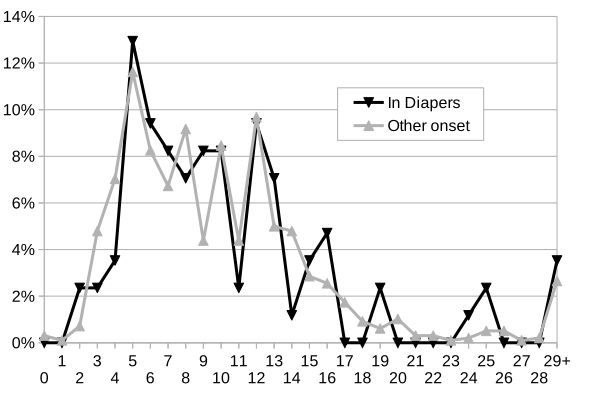
There are no known cases of paraphilic infantilism and diaper fetishism that didn't wear diapers during their infancy. However, the use of diapers later in life might not directly cause these conditions, as suggested by the data plotted in Figure #6. While the distribution of boys in diapers in the general population wasn't available, the distribution of boys who wet the bed at least once in the previous year is used as an upper limit [4].

This includes about 36% of five-year-olds. Each year, the number dropped by about one quarter on average. If there was a constant probability of developing an interest in diapers for each year that a boy spent in diapers, then the percentage of AB/DLs who reported being in diapers would drop off as quickly. It doesn't. Instead, the curve for AB/DLs who reported being in diapers was similar to those who were not.

Figure #6 - A histogram showing the age when AB/DLs, in diapers and not, became aware of their desires.  It also shows the percentage of boys who bedwet, and the rate at which that decreased.

It could be argued that those in diapers might have desires that don't surface until the diapers are removed. The negative of the time differential of the bedwetting curve is also plotted. This curve is the percentage of boys who stopped bedwetting at a given age. It would serve as an indicator of the percentage who were taken out of diapers at a given age. There is some correlation between the two curves, stopping bedwetting and AB/DLs in diapers. However, this correlation is weaker than the one between AB/DLs in diapers and AB/DLs not in diapers (r2=.67 vs r2=.91).

It should be noted that some factors would affect the onset and bedwetting curves differently. The age of onset was reported from the AB/DL's memory of his own childhood, sometimes decades afterwords. The bedwetting data is based on the parent's report of the child's current age. As a result, the rounding of uncertain ages would affect the onset curve, but not the betwetting curve.

After being taken out of diapers, a number of surveyees described intentionally wetting the bed to try to get put back in diapers.

The onset age histogram for AB/DLs in diapers has an exaggerated spike at age 5. (16% vs 10%, p=.02) This could be due to the push to achieve daytime continence before Kindergarten, or the social impact of not fully mastering that skill. It is also when the boys would be labeled as bedwetters.

AB/DLs both in diapers and out share the peak at 12 years of age. Interestingly, 3% of girls start wetting the bed again at this age. [4].

One key observation from the onset age histogram is that the dominant factors determining the age of onset for AB/DLs in diapers are similar to those not in diapers. That is, the dominant factors are common to those either in diapers or not in diapers at onset. Thus, the use of diapers after one's infancy is not a dominant factor.

Conclusion

While AB/DLs who had desired to be put back in diapers and those who were already in diapers when their desires started might seem worlds apart in their experiences, the survey results suggest that they are more similar than different. That is, the differences in experiences clearly affected the distribution of certain types of AB/DL. However, the various types are largely common between those who were and were not in diapers at onset.

Additionally, the various factors causing or influencing the desire for diapers and/or babyhood were also not greatly affected by the presence of diapers. This is shown by the distribution of the onset age distribution of AB/DLs who were in diapers. The age distribution is more similar to those of other AB/DLs than distributions for bedwetting.

Being in diapers would have two effects on the experiences of an AB/DL. First, being in diapers would have impact on a boy's self-image more than merely desiring to wear them would. Second, wearing diapers regularly might gratify the desire to wear them.

Children who aren't out of diapers, or were put back into them, have to deal with the impact to their sense of self. The child might be criticized by parents, teased by siblings, and ridiculed by classmates. This impact is the driving force in the polarity among AB/DLs who were in diapers late. They tended to either embrace or shun themes of babyhood and control.

Another experiential difference is that one who is wearing diapers for a need, such as incontinence or bedwetting, might not feel a desire to wear diapers. The paraphilic drive might be satisfied, and so be easily denied. An 'in diapers, in denial' group would then not consider themselves AB/DLs, and so not complete the survey. Their absence can explain many of the differences between the survey results AB/DLs who were in or not in diapers.

These results included an increased tendency to report being bisexual or homosexual, preferring not to have sexual partners, and to have positive feelings about AB/DL-related desires. These results might merely be because a population that would have tended to report preferring a partner of the opposite sex, and have a neutral or negative view of AB/DL-related desires wasn't included in the data.

Based on these observations, it seems clear that AB/DLs who desired to stay in diapers are not that different that AB/DLs who were in diapers already. There are quantitative differences in distributions, but not qualitative differences in substance. These differences might simply be due to the impact that being in diapers has on the self-image, and in some cases, a denial of gratified desires. AB/DLs who are incontinent or who bedwet might have had different experiences than AB/DLs who did not, but they themselves are not that different.

Email BitterGrey[mail] Level: General | Status: Finished | Last Update: 17 January 2009| First: 17 January 2009


Do you have Questions, Tips, Suggestions, or other feedback?
[icon] Books and Other References:
  1. Grey, B. T. Girls, Boys, and Diapers Retrieved 5 January 2009 from http://understanding.infantilism.org/surveys/girls_boys_and_diapers.php
  2. Kinsey, A. C., Pomeroy, W. B., Martin, C. E. (1948) Sexual Behavior in the Human Male. Philadelphia, W. B. Saunders Co. pg. 651
  3. Gangestad, S. W., Bailey, J. M., Martin, N. G. (2000). A taxometric analysis of sexual orientation and gender identity. Journal of Personality and Social Psychology, 78, 1109-1121
  4. Byrd RS, Weitzman M, Lanphear NE. Bedwetting in US children epidemiology and related behavior problems. Pediatrics. 1996;98 (3 pt 1):414-419 (PDF)

Creative Commons License
This work is licensed under a Creative Commons Attribution-Noncommercial-Share Alike 3.0 United States License. For online material based on this work, include a link to either this page, the ABDL Surveys Project index, or the website's main index. For printed material based on this work, include a citation with one of those three URLs.