 Understanding Infantilism (.org)
By B. Terrance Grey
This study was intended to explore the quantifiable factors of the childhoods of Adult Babies and/or Diaper Lovers (AB/DLs), primarily family size and birth order. It was hoped that these would shed some light on factors that are not consistently remembered, such as haste or difficulty in toilet training.
Some AB/DLs attribute their desires to having been the "baby of the family." Other AB/DLs attribute their desires to their position as the older sibling, displaced by the new baby. However, only children and small families appear to be overrepresented among AB/DLs.
Having a large number of younger siblings increased the likelihood of an AB/DL taking on parental duties, such as changing diapers. Additionally, the spacing between an AB/DL and the next younger sibling tended to decrease as the number of younger siblings increased. This tight spacing might have motivated the parents to push for early toilet training. These explanations for the development of desires towards diapers and/or babyhood in large families needs to be interpreted with the knowledge that the most overrepresented family size is the smallest.
Three possibilities were given for this. It is possible that the indications surveyed did not have a strong correlation with early childhood experiences. It is also possible that an AB/DL's desire to replace or relive parts of his or her infancy is based on relative perceptions. Finally, it is also possible that experiences and perceptions might influence the development of infantilism and diaper fetishism, but do not cause them.
While this study presented the distribution of birthorder among AB/DLs, further research is necessary for a more complete picture of the effects of familial factors.
When discussing the backgrounds of individual infantilists and diaper lovers, two narratives are common; that of the displaced older sibling, that of "the baby of the family."
The older sibling is, in many ways, defined by the displacement by one or more younger siblings. This displacement might be most influential on firstborns, who previously were only children. The parents might try to love every child equally, but the new arrivals will demand the bulk of their time and attention. The remainder might be divided among the older siblings, who might have to compete for it. The older siblings might be expected to be more responsible and more mature based on their relative ages, not their actual ages. Additionally, to avoid having multiple children in diapers, the parents might rush the older sibling's toilet training. The older sibling also might have to take on some parental duties, possibly including changing the diapers of much younger siblings. For older siblings, diapers and/or babyhood might come to symbolize the attention and privilege they lost when they were displaced as the baby of the family.
In contrast, a younger sibling might remain cast as the "baby of the family." This identity might be reinforced by siblings or parents. The youngest might not be as motivated to develop, since all the 'firsts' will have been already done by older siblings. Hand-me-downs that would go to the next baby might stay with them. They might stay in a crib longer, since it isn't needed for a younger sibling. The younger sibling might be more accommodated and more coddled, based on his or her relative age, not his or her actual age. For younger siblings, diapers and/or babyhood might come to symbolize their role as "baby of the family."
All siblings would generally have forgotten their own infancy, so the firsthand reality of diapers and babyhood would have been lost (Dave, 1997; MacDonald, Uesiliana, & Hayne, 2000). However, the older siblings might be able to replace it secondhand, by observing their younger siblings. These experiences, and the expectations based on relative age, would be yet another factor differentiating older and younger siblings. The younger sibling's move towards becoming an AB/DL would involve acceptance, while that of the older sibling would involve rejection or transition.
Many factors prevent direct study of an AB/DL's childhood. For example, AB/DLs might not remember when they were toilet trained, much less if they were physically and emotionally ready for it. Similarly, it is difficult to objectively quantify one's own mother as smothering or distant. This limits the testability of many theories on how upbringing and family relations affect paraphilic infantilism or diaper fetishism.
Given the difficulty in exploring toilet training, maternal attention, etc., this study will focus on objective metrics such as birth order and family size. To learn more about the effects birth order and family size on AB/DLs, this study used data from the second of the AB/DL survey series, as previously detailed by the author (Grey, 2009). The 64-question, online survey was composed and posted to the Internet at the author's website, understanding.infantilism.org. The questions briefly explored interests, practices, and backgrounds of AB/DLs. The survey was announced to a number of email and web-based AB/DL communities. Participation was voluntary and anonymous.
This survey included questions on siblings, with a particular interest in the next younger sibling. Four questions quantified the number of older and younger brothers and sisters. Options from zero to five or more were offered for each. There were also two questions on multiple births, and two on adoption or foster care. An essay question, on the effects the participant thought his or her siblings had on the development of AB/DL interests, was also asked.
A total of 997 responses were received for this survey, excluding responses from potential minors and probable duplicates. Of these, 715 self-identified as AB/DLs and completed all the relevant questions. The questions relevant to this paper are self-identification on the AB-to-DL range (S2Q3); multiple births, self(S2Q8) and siblings (S2Q14); older and younger brothers and sisters (S2Q9 -12); inter-sibling spacing (S2Q13); babysitting (S2Q15); and adoption or foster care, self (S2Q16) and siblings (S2Q17).
Chi-squared analysis was used to check multiple-choice questions or pairs of questions for statistical significance. Post hoc, the Benjamini-Hochberg procedure was used to test pairwise comparisons for significance within questions or question pairs that had shown a significant contrast. A 95% confidence and 5% false discovery rate was used.
Eight AB/DLs reported 5 or more older brothers, older sisters, younger brothers, or younger sisters. Neglecting any sixth, seventh, etc., older brothers, older sisters, younger brothers, or younger sisters that those eight AB/DLs might have gives a collective value of 1477 siblings reported by AB/DLs. The average AB/DL then would have come from a family with 3.07 children.
Figure 1 shows the distribution of the number of siblings reported by AB/DLs, compared to expectations based on US Census data (U.S. Census Bureau, 2008a). The US data was weighted by birth year, as family sizes are decreasing. The data is for mothers largely after the end of childbearing years (40-44). Since the median for childbearing was around 25-29 years of age, the data was offset by the fifteen-year difference.
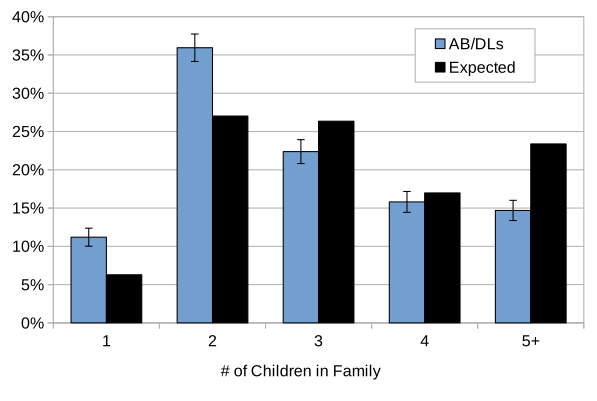
Using a Χ2 test for goodness of fit, relative to expectations based on the general U.S. population, showed that small families were overrepresented among the AB/DLs Χ2(4)=76.45, p<.001. Individually, the contrast was significant for all but four children; 1 child, post hoc Χ2(1)=29.26, p<.001; 2 children, Χ2(1)=28.87, p<.001; 3 children, Χ2(1)=5.79, p=.02; 4 children, Χ2(1)=0.70, p=.4; 5 or more children, Χ2(1)=30.17, p<.001.
Anecdotally, paraphilias are associated with white males. The calculation of expected values was repeated with partial compensation for race and ethnicity, using U.S. Census data (1998, 2002, 2006, 2008). However, for the birth years represented, the racial compensation did not shift expectations substantially. For example, the expected probability of a child reporting being an only child changed from 6.3 to 6.1%. The effect of racial compensation might be larger for later birth years, due to the decreasing majority of white families in the U.S.
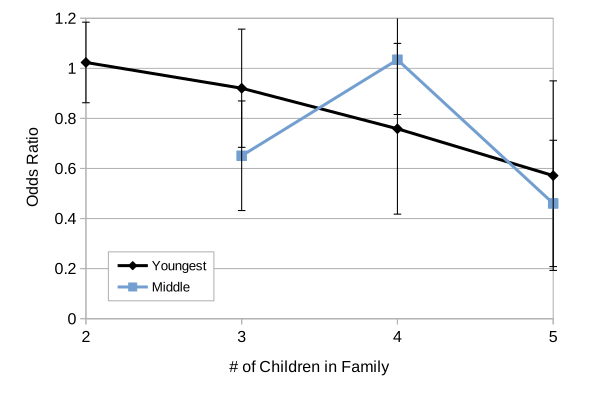
Figure 2 shows the probably of a sibling reporting being an AB/DL, relative to the firstborn of the family. Possibly due to small subsample sizes, neither curve differed significantly from expectations based on the family size reported by firstborns (for middle children, Χ2[2]=3.09, p=.2, after compensating for a firstborn of four implying two middle children, etc.; for youngest, Χ2[3]=2.96, p=.4).
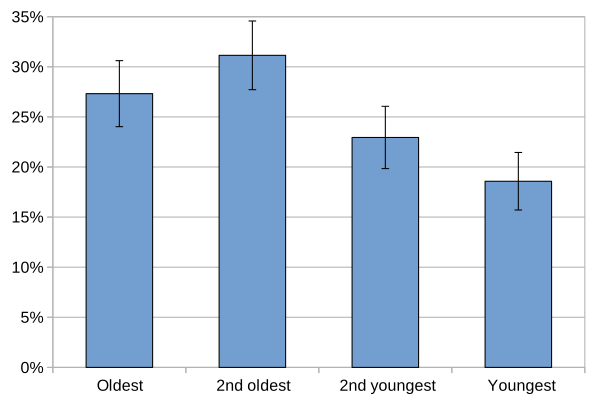
For large families, Figure 2 can be obscure because it averages all the middle children together. For families of four or larger, Figure 3 shows the distribution of AB/DLs who reported one of four birth ordinals. 30% of AB/DLs (213) reported coming from families with four or more children. Of those, 4% (30) reported being in an ordinal not shown, such as the third of five, the third or fourth of six, etc. Given this, since each of the four ordinals shown occur only once in a family, AB/DLs would be expected to have an equal probability of reporting being from each ordinal. A Χ2 test for goodness of fit showed that the probability of becoming an AB/DL did not vary significantly with the reported birth ordinal, Χ2(3)=6.49, p=.09.
Larger families might tend to place more pressure on the older siblings to mature quickly. Two indications of this pressure are plotted in Figure 4. One indication is a sibling born within two years of the AB/DL. This creates the frequently bemoaned situation of having "two under two". A desire not to have multiple children in diapers might lead to rushing the older child's toilet training. One man summarized "three younger siblings all one year apart so lots of pressure to get me out of diapers."
While this pressure would be expected to be more common in large families, it was not unique to them. One wrote about his only sibling, a sister. "When she was born, it made my parents rush potty training me, trying to get it over with quicker than most parents would, so they would not have two kids in diapers. So I feel that the potty training was done quickly, carelessly, and selfishly."
Spacing would put second-borns in a unique position: They would never have had the only-child focus, yet might still need to compete with other and younger siblings for attention.
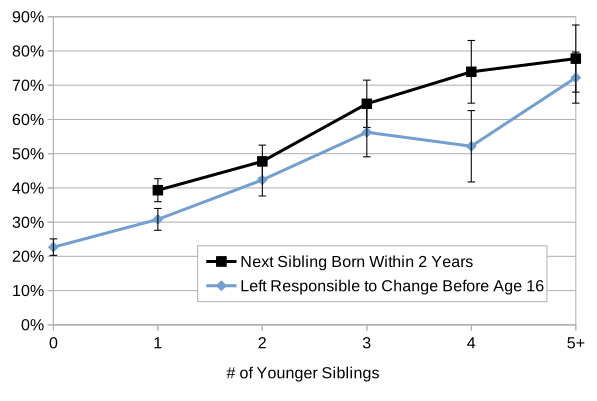
Also shown in Figure 4 is the distribution of AB/DLs who were left responsible to change diapers before the age of 16. These responsibilities may have been for a much younger sibling or as part of a babysitting job. Unless rewarded with babysitting pay, they might be yet another reason to be envious of younger and less-burdened siblings. In addition to delineating the contrast between responsible adult and carefree baby, these duties would ensure that diapers were present and accessible.
These duties did not universally fuel envy. One man with seven or more younger siblings commented "I was the oldest so I liked looking after those in diapers."
Two intuitive explanations for why AB/DLs might come from large families, spacing and inattention, were explored. Large families tend to have a tighter spacing, so toilet training might be rushed to avoid having multiple children in diapers at the same time. Additionally, the attention of parents might be thinly divided among the children of large families. Care for the younger siblings might be delegated to the older siblings. However, that large families are not dramatically overrepresented suggests that the effect of these factors is limited, or comparable to other factors. One possible factor not covered was the mother's profession: A housewife with six children might have more attention to give to each than a woman with a career away from the home and one child in daycare.
It might simply be that a child's desire to relive infancy is influenced by the perception that infancy was better than the child's life now. This perception might be remarkably subjective, swayed more by optimism, nostalgia, and covetousness than reality.
In addition to birth order, the gender of siblings might play a role. A man with one older sister wrote "my older sister used to diaper me whenever we played house [and] even paraded me around the house in just a diaper." He had two younger siblings. An incontinent AB/DL without brothers reported that "With two older sisters I was always in diapers and dresses due to the fact that I was their living doll to play with in the absence of parents. Dad [was] gone due to [the] military and mom [was] working long hours." One woman, the third of four girls, wrote 'my sisters would make me be the baby when playing house, and would put me in my younger sister's diapers and rubber or plastic pants."
Playing house was not exclusive to those with older sisters. One man recalled "my earliest recollections of wanting to role play were with the kids next door and playing house. I was about 5 or 6 and always wanted to be the baby. I think it had to do with the fact that I have a younger brother, and he got all the attention that I used to get once he was born." He was the oldest of two.
In contrast, younger brothers might be more likely to bedwet than younger sisters. One man, the oldest of four boys, mentioned "I wet the bed and all of my younger brothers made it very difficult for me." One man commented of his younger, only brother "My brother wore disposable diapers for bed wetting. I always wanted to wear one too but was never allowed."
Collectively, AB/DLs reported 339 older brothers and 333 older sisters, with 133 and 150 being cases of only older brothers or sisters, respectively. They also collectively reported 424 younger brothers and 364 younger sisters. (These values do not include the additional siblings of the the 17 AB/DLs from multiple births.) If neither of these narratives had an influence, the sex ratio of siblings would be expected to be around 1.052 (Mathews, Brady E. Hamilton, 2005). While these recurring narratives offer an intuitive explanation, a Χ2 test for goodness of fit showed that neither having only older sisters (Χ2[1]=2.11, p=.1) nor more younger bothers (Χ2[1]=2.11, p=.1) were statistically significant.
The effect of familial insecurity can be shown by the prevalence of foster care and adoption. Eight percent (59) of AB/DLs reported having been adopted or placed in foster care (Fostered to be brief), including four percent (27) who reported also reported having one or more siblings who were fostered. Overall, 6% of AB/DLs (42) reported having one or more siblings that were fostered, and they reported an average of 2.9 siblings. Since the survey did not ask for the number of siblings fostered, this value is unknown. The AB/DL was not more likely to have been fostered than to be in a family that has other fostered children, as shown by a Χ2 test for goodness of fit, Χ2(1)=2.86, p=.09. However, if we assume an independent probability of having been fostered, we would expect an average of 2.07 fostered siblings per fostered AB/DL, based on the average number of siblings per AB/DL. Relative to this expectation, AB/DLs are significantly more likely to have been fostered, as shown by a Χ2 test for goodness of fit, Χ2(1)=30.7, p<.001.
Foster children might be the most elegant narrative of how one's childhood might lead to a desire not to only relive one's infancy, but to replace one's infancy. Ideally, they would be leaving a bad home for a better one. In this better home, they might have had a better infancy, or at least develop the perception that it would have been better.
According to U.S. census data (2010), 2.0% of births were multiples after adjusting for birth year. Since these were almost all twins, they resulted in 4.0% of the population. In contrast, only 2.4% (17) of AB/DLs reported being a twin. As shown by a Χ2 test for goodness of fit, twins and triplets are underrepresented among AB/DLs, Χ2(1)=4.90, p=.03.
Overall, these results suggest that upbringing has an influence on the probability of becoming an AB/DL. However, they did not show a strong influence. As the data was retrospective and reported by the AB/DL, as opposed to the AB/DLs' parents, potential factors needed to be explored indirectly. The survey attempted to explore some early childhood factors, such as parental attention and rushed toilet training, using less subjective indications, such as birth order and family size. Furthermore, the survey omitted details, such as stillbirths and other aspects of maternal history that were not represented by the current composition of siblings. It also did not handle adoption and foster care robustly. Additionally, the values used for comparison were derived from U.S. Census data, and so might not be appropriate for the international AB/DL community. Finally, the second survey did not include questions on ethnicity, race, education level, and birth place. As a result, the results can not exclude these potentially confounding factors.
Nonetheless, the results showed that AB/DLs come from every family size, and from every birth order. The distributions suggest that some combinations were more likely to become AB/DLs than others, but the extent of these trends was limited.
The results, overall, suggest that one's childhood does have an effect on the probability of becoming an AB/DL. For most factors surveyed, these effects were limited. It is possible that the indications surveyed did not have a strong correlation with early childhood experiences. For example, a working woman with a career may have less time for her one child than a housewife with six has for each of her children. It is also possible that an AB/DL's desire to replace or relive parts of his or her infancy is based on relative perceptions. For example, a bad childhood would only fuel a desire to relive infancy if it was paired with optimism, nostalgia, or covetousness. Otherwise, there would be the expectation that infancy would be equally bad. Finally, it is also possible that experiences and perceptions might influence the development of infantilism and diaper fetishism, but do not cause them.
Email BitterGrey![[mail]](../figures/email_icon.gif) Last Update: 10 Jan 2017| First: 3 December 2010
Last Update: 10 Jan 2017| First: 3 December 2010
Do you have Questions, tips, suggestions, or other feedback?
![[icon]](../figures/puzzle_ref.gif) Books and Other References:
Books and Other References:

This work is licensed under a
Creative Commons Attribution-Noncommercial-Share Alike 3.0 United States License.
For online material based on this work, include a link to either this page, the
AB/DL Surveys Project index, or the
website's main index. For printed material based on this work, include a citation with one of those three URLs.