 Understanding Infantilism (.org)
By B. Terrance Grey
An important piece of groundwork for a detailed understanding of the paraphilias is, simply put, a map. Maps are essential for communication, exploration, and understanding. Intending to build this groundwork, the results of an online survey of Adult Babies and Diaper Lovers (AB/DLs) were explored. It had questions addressing the importance of four aspects of paraphilic infantilism and diaper fetishism; 1) the feeling, smell, and sound of diapers 2) sex, 3) control, and 4) babyhood.
Many AB/DLs report considered the feeling, smell, and sound of diapers to be important. The reported importances of control and babyhood were somewhat correlated, with some AB/DLs considering them important, and others reporting that they must be absent from their AB/DL games, scenes, and activities. However, as they were not consistently equal, they might need to be treated as independent axes.
AB/DLs were similarly divided on the importance of sex as an aspect of AB/DL games, scenes, and activities. Contrary to how strongly sex and paraphilia are associated in literature, many AB/DLs did not consider it an important aspect. Additionally, a substantial segment of the population practices sex but does not consider it an important part of their AB/DL interests. This suggests that sex is not inherently a part of infantilism.
The interests involved with paraphilic infantilism and diaper fetishism have been shown to be more enlightening than the practices. This study introduced the four dimensional Control-sex-babyhood (CSB) disc plot, the most detailed map of these interests to date, which might help express many future advances. However, while useful for analysis, the CSB disc plot of AB/DL interests might not replace the simpler but less powerful maps, such as the venerable triangle diagram.
Maps are essential for communication, exploration, and understanding. However, accurate maps are still needed for paraphilic infantilism and diaper fetishes, which have been generalized in many ways, but not accurately understood.
In 1910, something similar to paraphilic infantilism was described by R. Pettow, under the name "infantosexual transvestism" (Allen, 1969). This observation included the generalization that "the patient seems usually to be a woman." More recent descriptions have a more accurate ratio of 20 male paraphilic infantilists for each female (APA, 2000). Descriptions have improved over time, but many are crippled by the assumption that paraphilic infantilists and diaper fetishists are a homogeneous group. A still better description characterizes the population along an AB-to-DL spectrum (Grey, 2006). However, this description is limited, as subgroups along that spectrum were not necessarily homogeneous.
In 1995, the author presented a more detailed description of paraphilic infantilism and diaper fetishism (Grey, 1995). A more recent version of this figure is shown in Figure 1. This described the AB/DL map as a triangle, and was based on an overview of published material, as well as the fiction and reported fantasies that were being posted to usenet's alt.sex.fetish.diapers. These references tended to emphasize one of three themes, paralleling fetishes, masochism, and transvestism respectively. This parallel also eased communication, since the common understanding of fetishes, masochism, and transvestism is at least superficially correct.
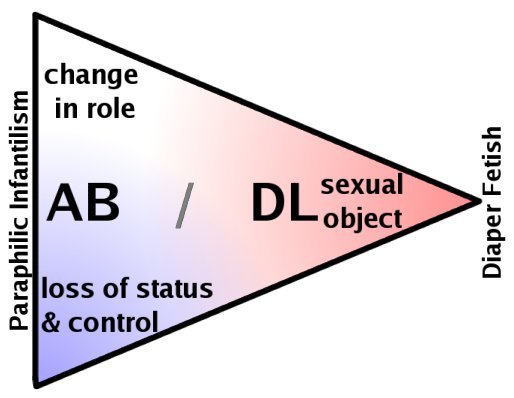
AB/DLs in the rightmost corner of the triangle focus on diapers as sexual objects, as fetish items. Their fantasies center on what erotic things they (or they and their partners) would do with the diaper.
AB/DLs in the top corner use diapers to express their inner role, as a baby. This is similar to how a transvestite assumes the clothing of a woman as part of assuming the role and identity. The exception being that these AB/DLs realize that they can't change themselves surgically, as a transsexual might. This theme tends to use first person language, since the diaper is a comment about the self - "I'm a baby".
AB/DLs in bottom corner enjoy being deprived of adulthood, comfort, and control. Diapers become a symbol that someone else is in control. This might involve second-person language - "Mommy" does this or that. This is analogous to someone who enjoys surrendering control to others, a masochist. As is the case with masochism and transvestism, there is some apparent overlap. For example, male transvestites might crossdress to express their femininity, while male masochists might be crossdressed to deprive them of their masculinity.
It might be possible to be blissfully contented, erotically aroused, and ashamed at the same time, but not common. Except in such instances, these themes are momentarily exclusive. However, the focus of a fantasy or scene could easily change from moment to moment. If AB/DLs averaged the emphasis over time, they would end up somewhere on the triangle. The interests of individual AB/DLs might also shift over time.
One drawback to the triangle is that both those who did not value any of the three themes, and those who valued all three equally, would be mapped to the middle of the triangle.
Pate and Gabbard (2003) published an article describing four cases involving diapers and masturbation. The first case repeatedly stated his desire to be a baby, using mostly first-person language ("I want to be a baby"). Three other cases were drawn from other papers. One of these cases fantasized about the approval of an older woman, who came to resemble his mother during analysis (Malitz, 1966). Another did not involve either a change in who he was, or the involvement of a mother figure (Tuchman & Lachman, 1964). The fourth case was physically, psychologically, and socially retarded (Dinello, 1967). The title, "Adult Baby Syndrome," was a reference to an episode of a television program, "ER." Pate and Gabbard's article stopped short of asserting that these dissimilar patients all had the same syndrome.
Isolating the one or more syndromes present in AB/DLs will first require finding similar patients. Expressing this similarity will require a map of some form.
This study used data from the first of the AB/DL survey series, as previously detailed by the author (Grey, 2006). The 38-question online survey was composed and posted to the Internet at the author's website, understanding.infantilism.org. The questions briefly explored interests, practices, and backgrounds of AB/DLs. The survey was announced to a number of email and web-based AB/DL communities. Participation was voluntary and anonymous.
A total of 1489 responses were received for this survey, excluding responses from minors and probable duplicates. Of these, 1296 self-identified as AB/DLs and completed all the relevant questions. The questions relevant to this paper are self-identification on the AB-to-DL range (S1Q4); the importance of aspects feeling/sound/smell (S1Q8), sex (S1Q9), control (S1Q10), babyhood (S1Q11), and convenience (S1Q12); the importance of the right diaper (S1Q27); and the presence of sex in AB/DL games, scenes, and fantasies (S1Q32).
Currently, paraphilias are defined by their interests. In the simplest sense, paraphilic infantilism and diaper fetishes are defined by an interest in diapers, babyhood, etc. As a result, any map compatible with the current terminology would need to focus on interests.
The survey included a list of five aspects of AB/DL games, scenes, and fantasies.
The participants were asked to rate the importance to them in AB/DL games, scenes, and fantasies as either Very Important, Important, OK, Tolerable, or Must be absent. The results of these questions were analyzed in both relative and absolute terms. The overall distribution of the absolute importance of these interests is plotted in Figure 2.

The correlation of babyhood and control themes is plotted in Figure 3. Since both involve roleplay and have other superficial similarities, considerable overlap was expected. Especially in the extremes, there was a tendency to report both themes as having the same importance: Nine and eight percent of AB/DLs reported both being very important or must be absent, respectively. Overall, the two were somewhat correlated (R=0.18) with 35% (451) of AB/DLs reporting the same importance for the themes of babyhood as control.

A similar correlation occurred between the importance of sexual themes and the presence of sexual practices (R=0.22), plotted in Figure 4. To avoid categories of fewer than 5, those who reported a positive importance (S+, either very important or important) for sex and those who reported a negative importance (S-, either tolerable or must be absent) were grouped. Twenty seven percent of AB/DLs reported both a positive importance for sex in, and unrestricted sex during AB/DL games, scenes, and fantasies. In contrast, other AB/DLs moderated the types of sexual activities that they would engage in during scenes and fantasies. Seven percent of AB/DLs both reported a negative importance of sex in, and excluded sexual practices from, their AB/DL games, scenes, and fantasies.
The bulk of the AB/DL population was somewhere in between. Sex might be present while not necessarily part of the core paraphilia. One of the four cases cited by Pate and Gabbard is an example of this, although an atypical one: Dr. Dinello's patient believed that using his hands to masturbate was morally wrong, and so used the diaper for stimulation instead (Dinello, 1967). Religious beliefs caused the masturbation into the diaper, while the diaper was present for other reasons. Clearly, the broad presence of sex doesn't necessarily imply a broad importance.

The relative importance of the four aspects are summarized in Figure 5 and listed in Table 1. A high relative importance of sex, control, and babyhood themes was expected, because of their frequency in fantasy and fiction. Fantasies, stories, and scenes typically have a narrative of some form: There is usually something happening. However, these might be artificial structures, built around a central desire. The dominance of feeling/sound/smell suggests that the diaper is more than just a common element among many AB/DLs, but the core element in the urges of paraphilic infantilism and diaper fetishism.

| Most Important Aspect | % | n |
| Feeling/sound/smell only | 35% | 456 |
| Feeling/sound/smell & sex tied | 13% | 170 |
| Feeling/sound/smell & babyhood tied | 12% | 150 |
| Feeling/sound/smell & control tied | 6% | 79 |
| Babyhood only | 6% | 73 |
| Feeling/sound/smell, control, & babyhood tied | 6% | 73 |
| Control only | 5% | 62 |
| Sex only | 5% | 60 |
| Control & Babyhood tied | 3% | 42 |
| Feeling/sound/smell, sex, & control tied | 3% | 41 |
| Feeling/sound/smell, sex, & babyhood tied | 3% | 34 |
| All four aspects tied | 3% | 34 |
| Sex & control tied | 1% | 11 |
| Sex & babyhood tied | 1% | 8 |
| Sex, control, & babyhood tied | 0% | 3 |
The relative importance of the feel, sound, and smell of diapers shows a commonality among the majority of AB/DLs. 89% (1154) of AB/DLs consider the Feel/Sound/Smell of diapers important or very important. Similarly, only 9% (121) of AB/DLs report that the convenience that diapers offer is tolerable or must be absent. The exceptions to these clear majorities may be worthy of further study, but mapping should focus on the areas of diversity; the themes. While the themes of loss of control, sex, and change in role might not be the as important as previously thought, preference for particular themes remains a reasonable way to group AB/DLs. Grouping by interest is also consistent with the conventional system for defining paraphilias.

The most populous interest node included those who considered all three themes important or very important. It represents 11.4% (148) of AB/DLs. This node is marked Control positive, Sex positive, and Babyhood positive, or C+S+B+ for short. 10.6% (137) of AB/DLs considered sex OK but placed importance on control and babyhood, C+S0B+. The next node to the left, C+S-B+, represents 5.4% (70) of AB/DLs. These AB/DLs considered control and babyhood either 'important' or 'very important', but sex was 'tolerable' or 'must be absent.'
There is also a large node contrasting with these three, C-S+B-. These AB/DLs considered sex either 'important' or 'very important', but control and babyhood to be 'tolerable' or 'must be absent.' The C-S+B- node represents 10.0% (130) of AB/DLs.
The American Psychiatric Association (APA) defined paraphilic infantilism is a sub-group of "Sexual Masochism," marked by wearing diapers and being treated like a baby (APA, 2000). That is, a positive importance of sex (S+) as well as a positive importance for babyhood (B+), control (C+), or both (C+B+). These nodes are colored white in Figure 6. This includes five nodes, representing 26.4% (342) of AB/DLs. Sex is also central (S+) to fetishism. Not counting the nodes included in paraphilic infantilism, this includes four nodes, representing 20.6% (267) of AB/DLs. The remaining 53.0% (687) of AB/DLs are excluded by these definitions.
Technically, Figure 6 is a five-dimensional plot, correlating three major themes among AB/DLs with the population distribution and APA definitions. It might be extremely useful as a research tool, but might not replace simpler representations in casual conversation. It is also important in that it is an interest-based map. Approaches that focused on practices often gave distorted results, since some practices follow from interests other than paraphilic infantilism or diaper fetishism. For example, a large segment of AB/DLs practice sexuality but considered it an unimportant aspect of their AB/DL interests. The gap between practice and interest might be the result of other fields of interest, such as heterosexuality, homosexuality, religion, etc. This gap might be one cause for the perception that all paraphilias are sexual in focus and expression. This perception is reinforced by the presence of sexual practices, but as shown by the survey data, not consistently supported by an importance of sex as an AB/DL aspect.
When only a handful of cases were available, grouping all AB/DLs together was reasonable, although the reliability of generalizations suffered. For example, Dinello's patient clearly required medical intervention (Dinello, 1967), and is distinguished from most AB/DLs by physical and mental retardation. In contrast, a more characteristic example of paraphilic infantilism, Pate's patient, clearly did not benefit from professional help (Pate & Gabbard, 2003). The present study, drawing on responses from over a thousand AB/DLs, provides dramatically more data than ever available before. The more detailed map of AB/DL interests that it provided might aid future research. This might offer more insight into what causes paraphilic infantilism and diaper fetishes. It might also give a clearer picture of which AB/DLs, if any, might benefit from medical help.
Only by mapping out heterogeneity and then studying homogeneous groups can paraphilic infantilism and diaper fetishism be accurately and inclusively defined. By understanding the diversity present in AB/DLs, we will be better able to address any needs they might have.
Of course, this research is not without limitations, including those common to surveys of voluntary, self-selected participants. While it introduced a powerful means of describing the interests of AB/DLs - the CSB disc plot, it did not take the next step of exploring the alignment of various other AB/DL interests and activities to locations on the CSB disc plot. That is, a predictive capacity hasn't been shown. Finally, the descriptive capacity of the CSB disc plot might be limited. First because it is a discretized representation of data that is reasonably expected to be continuous. Second, by dividing the population into 27 nodes, there is a risk that it might divide the data from potential future applications into too many categories, and to loose resolution. A 3D scatter plot could address these, but would not be without its own limitations.
![[mail]](../figures/email_icon.gif) Last Update: 22 Dec 2016| First 27 May 2007
Last Update: 22 Dec 2016| First 27 May 2007
Do you have Questions, tips, suggestions, or other feedback?
![[icon]](../figures/puzzle_ref.gif) Books and Other References:
Books and Other References:

This work is licensed under a
Creative Commons Attribution-Noncommercial-Share Alike 3.0 United States License.
For online material based on this work, include a link to either this page, the
AB/DL Surveys Project index, or the
website's main index. For printed material based on this work, include a citation with one of those three URLs.